Written by: Jocelyne A. Macelloni, Esq.
Part I of a three-part series exploring how early issue identification, sanctions strategy, and fee recovery can combine to achieve a total defense victory.
Introduction: The Case for Day-One Strategy in Florida Litigation
Litigation success rarely begins in the courtroom, it begins at intake. The first conversations with a client, the initial case review, and the framing of affirmative defenses all determine whether a matter will be resolved in months or spiral into years of discovery and hearings.
At Barakat + Bossa, our philosophy is simple: Strategy begins on day one. Each motion, response, and procedural step must not only address the issue at hand but also anticipate the next two. The following case, which resulted in a complete summary judgment victory, illustrates how that philosophy operates in practice. An early understanding of the core defenses shaped the trajectory of the entire litigation and laid the groundwork for sanctions and fee recovery in subsequent proceedings.
Background: A Multi-Faceted Dispute
The Plaintiff brought a multi-count action asserting claims of constructive fraud, unjust enrichment, accounting, statutory violations, and fraudulent transfers against our clients. The allegations stretched across a range of assets including real estate, corporate shares, annuity proceeds, insurance payouts, and personal property.
At first glance, it was a complex web of overlapping relationships and transactions. But rather than get lost in the factual tangle, the defense focused immediately on identifying whether any of these claims were viable as a matter of law. That question, not the facts, would prove decisive.
Why Summary Judgment Strategy Starts Before the Complaint
Even before discovery began, the Defense team reviewed public filings, corporate documents, and trust instruments to assess potential legal bars to recovery. Two issues defined the case: Florida’s statute of limitations and standing. Every alleged act occurred more than four years before filing, implicating Florida’s statute of limitations; and the Plaintiff had no standing because the trust never owned any of the assets at issue.
These findings shaped everything that followed. By identifying dispositive defenses at the outset, the team ensured every motion and argument built toward the same endgame: summary judgment strategy.
The Defense Strategy: Aligning Substance with Procedure
Once the core defenses were identified, the litigation plan was designed around reinforcing them at each procedural stage.
Early Motion Practice. In response to every iteration of the complaint, there were three, the defense filed Motions to Dismiss for lack of standing and that all claims were barred by the statute of limitations for fraud. Each Motion asserted that these defenses were apparent on the face of the complaints based upon the timeline set forth by the Plaintiff. Two of the three motions were granted on the standing issue, forcing the Plaintiff to better articulate their claims and to box the Plaintiff in in a position.
When the Plaintiff filed the first amended complaint, the defense maintained its focus on the same issues. Rather than scatter resources across peripheral claims, the team reinforced the same legal bars and served an early Motion for Sanctions pursuant to Florida Statute § 57.105, warning that any continued assertion of claims for which the Plaintiff lacked standing to assert could lead to sanctions.
Affirmative Defenses. The Defendants’ first and second affirmative defenses asserted that all claims were barred by the statute of limitations and that the Plaintiff lacked standing. This preserved those issues for dispositive motion practice later, while also signaling to opposing counsel that the case rested on legally fragile ground.
Summary Judgment. By the time the motion for summary judgment was filed, the Court had already seen these arguments repeatedly, reinforcing the summary judgment strategy. That consistency lent credibility and clarity. The motion framed the question as one of law: whether the Plaintiff could legally maintain the claims at all and that after nearly two years, the Plaintiff had failed to present any evidence to counter the first and second affirmative defenses.
The Court’s Findings
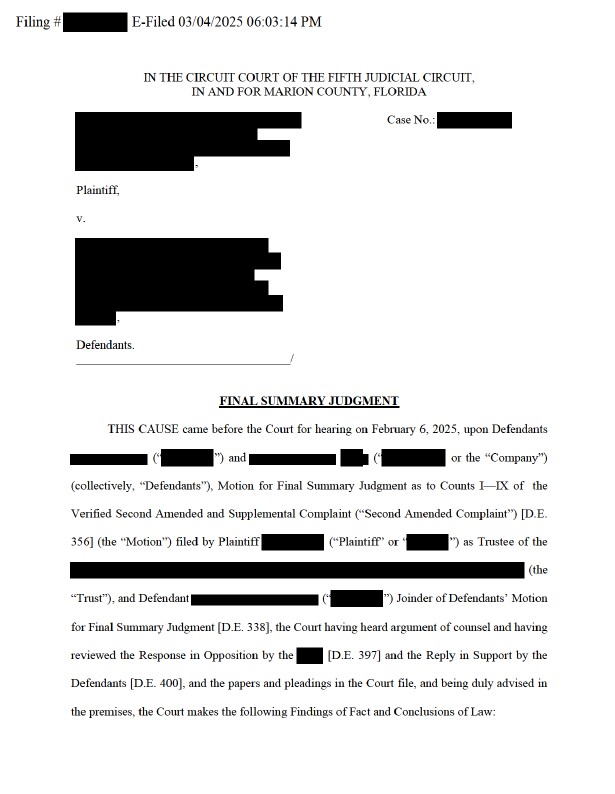
On March 4, 2025, the Circuit Court granted Final Summary Judgment in favor of the Defendants. The Court held that all nine claims were barred by Florida’s four-year statute of limitations and that the Plaintiff, whether acting individually or as trustee, lacked standing to pursue them.
The Court further found that the trust never owned the disputed corporate shares, which were held jointly by two individuals with right of survivorship. When one owner passed away, the survivor became sole shareholder, extinguishing any ownership claim by the trust. Similarly, once assets were withdrawn from the revocable trust, they became the settlor’s personal property, no longer subject to trust claims or accounting obligations.
In one ruling, the Court resolved the entire dispute validated the defense’s day-one analysis.
Strategic Impact: Building a Case Backward from the Goal
The Summary Judgment wasn’t the product of chance; it was the predictable result of a strategy built backward from the desired outcome.
By focusing on threshold legal issues from day one, the defense avoided unnecessary discovery battles, limited motion practice to dispositive matters, and kept the Court’s attention on the governing law. Every filing reinforced the same narrative: The Plaintiff’s claims were not merely weak, they were legally barred.
That clarity created momentum. By the time the Court rules, the decision felt inevitable not surprising. The ruling didn’t just end one case; it established the foundation for the next phase of the defense plan, using Florida Statute § 57.105 to preempt any attempt to relitigate the same issues.
The Broader Lesson: Strategic Sequencing as Risk Management
Effective litigation management requires more than reacting to pleadings. It requires planning around outcomes. A well-sequenced defense is part of strategic litigation planning that not only limits exposure but also builds a record supporting fee recovery, sanctions, and early resolution in related cases.
The Defendants’ success here demonstrates the value of starting with the end in mind. The same defenses that secured summary judgment would later underpin the § 57.105 sanctions demand, and ultimately, entitlement to attorney’s fees. In other words, each victory wasn’t isolated, it was a step in a deliberate sequence designed to reach finality on both liability and cost.
Looking Ahead
That disciplined approach to planning, from initial review to final motion, illustrates what winning before the finish line looks like in practice.
In Part II, we’ll examine how the next more in the defense sequence, a carefully timed § 57.105 sanctions notice, turned the summary judgment victory into a deterrent against duplicative litigation.
Jocelyne A. Macelloni is a partner and director of education at Barakat + Bossa PLLC. Board-certified by the Florida Bar in business litigation, Ms. Macelloni has spent more than a decade representing businesses and business owners in courts and arbitrations around the U.S., including in cross-border transactions and disputes that involve enforcing factoring companies’ and secured creditors’ rights. Her practice focuses on helping companies resolve complex disputes efficiently—by identifying winning strategies early, minimizing risk, and turning litigation into a controlled, strategic process rather than a reactive one. For assistance, Ms. Macelloni can be contacted at jmacelloni@b2b.legal.
This post is intended to provide general information regarding civil litigation strategy in Florida and does not constitute specific legal advice. For guidance tailored to your situation, please contact our team directly.