Written by: Jocelyne A. Macelloni, Esq.
Part II of a three-part series exploring how early issue identification, fee-shifting tools, and procedural planning combine to achieve a total defense victory.
Introduction: Strategy is a Continuum, Not a Reaction
Litigation strategy does not end with the granting of summary judgment. For defendants, the next phase often determines whether the victory will be meaningful in practice or merely symbolic. A prevailing party who walks away without recovering the cost of litigating, even when the claims were legally defective from the outset, has only achieved half victory. The hallmark of sophisticated defense work is ensuring that success on the merits is paired with a financial remedy that reflects the strength of the defense from day one. In this matter, the Proposal for Settlement served as the bridge between legal exoneration and fee entitlement.
Early Recognition of Fee Pathways
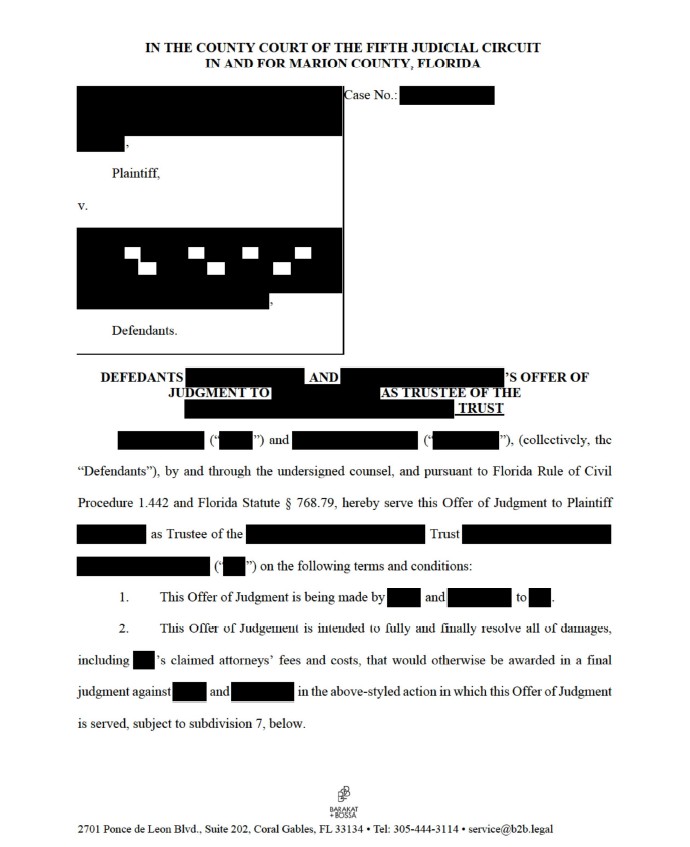
Long before dispositive motions were filed, the Defense analyzed not only the substantive weakness of the Plaintiff’s claims but also the procedural tools available to convert those weaknesses into leverage. The Plaintiff’s claims but also the procedural tools available to convert those weaknesses into leverage. The Plaintiff’s lack of standing and the clear statute-of-limitations bar made it probable that the case would ultimately be resolved on legal grounds rather than factual ones. But prevailing on the merits alone does not guarantee reimbursement. With that in mind, the Defense evaluated the timing and structure of a Proposal for Settlement early in the litigation, identifying it as a mechanism that could preserve the Defendants’ ability to recover fees if the Plaintiff insisted on pursuing untenable claims.
Victory to Value: Strategic Deployment of the Proposal for Settlement
Florida’s offer of Judgment, § 768.79, is often misunderstood as a settlement tactic when, in reality, it operates as a powerful fee-shifting device. When properly drafted and served, a proposal that is rejected becomes a statutory trigger once the defendant obtains a judgment of no liability. Here, the Defense served the Proposal for Settlement early, at a moment when the record already reflected the central legal deficiencies but before the parties had incurred unnecessary expense. This timing was intentional. The early service of the proposal demonstrated the Defendants’ willingness to resolve the case efficiently while positioning them to recover fees if the Plaintiff chose to continue litigating despite the clear legal barriers to recovery.
The Court’s Ruling on Entitlement
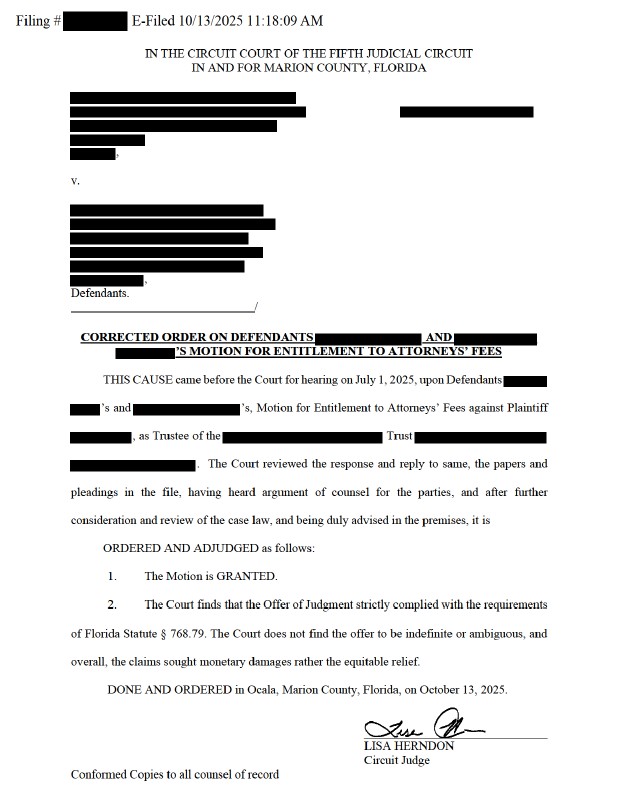
The Plaintiff’s rejected the proposal. That decision had consequences. When the Court later granted final summary judgment in favor of the Defendants, adopting the same legal theories the Defense had preserved from the outset, the Proposal for Settlement became operative. Because the Defendants had offered to pay the Plaintiff money and ultimately the Plaintiff recovered nothing, the statutory entitlement to fees was automatic. The Defense timely moved for entitlement within the thirty-day deadline imposed by Rule 1.525, and the Court found that the proposal complied with all procedural requirements, was made in good faith, and applied to the monetary claims asserted. With those findings, the Court confirmed that the Defendants were entitled to reasonable attorneys’ fees from the date the Proposal for Settlement was served, with a specific amount to be determined at a later hearing.
Strategic Impact: A Cohesive and Forward-Looking Defense Record
The Proposal for Settlement thus served a dual purpose. Substantively, it reflected the Defense’s confidence in the legal deficiencies of the claims. Procedurally, it created a financial framework that would allow the Defendants to recoup a significant portion of their litigation costs once the Court ruled in their favor. By integrating the proposal into the litigation strategy months before dispositive motions were heard, the Defense ensured that the financial consequences of pursuing legally invalid claims would not fall solely on the Defendants. The proposal also reinforced the narrative that the Defense had maintained throughout the case. A narrative grounded in professionalism, discipline, and reliance on the governing law rather than rhetoric or overreach.
Establishing a Financial Foundation for Finality
In many cases, fee entitlement is fought after judgment, with parties scrambling to identify viable mechanisms at the eleventh hour. Here, the Proposal for Settlement ensured that entitlements flowed naturally from the same record the Court relied upon to enter judgment. It transformed the summary judgment victory into a financial one and ensured that the Defense’s early recognition of the case’s legal defects resulted not only in dismissal but also in reimbursement.
In part III, we examine how the Defense continued this strategic sequencing by using statutory mechanisms to expand the scope of recoverable fees through Florida Statute § 57.105.
Jocelyne A. Macelloni is a partner and director of education at Barakat + Bossa PLLC. Board-certified by the Florida Bar in business litigation, Ms. Macelloni has spent more than a decade representing businesses and business owners in courts and arbitrations around the U.S., including in cross-border transactions and disputes that involve enforcing factoring companies’ and secured creditors’ rights. Her practice focuses on helping companies resolve complex disputes efficiently—by identifying winning strategies early, minimizing risk, and turning litigation into a controlled, strategic process rather than a reactive one. For assistance, Ms. Macelloni can be contacted at jmacelloni@b2b.legal.
This post is intended to provide general information regarding civil litigation strategy in Florida and does not constitute specific legal advice. For guidance tailored to your situation, please contact our team directly.