Written by: Jocelyne A. Macelloni, Esq.
Part III of a three-part series exploring how early issue identification, sanctions strategy, and fee recovery can combine to achieve a total defense victory.
Introduction: Protecting the Integrity of a Defense Victory
A favorable ruling does not end a dispute when the opposing party is determined to keep litigating issues the Court has already resolved. After securing a complete summary judgment win, the Defense understood that the real risk was not an appeal or reconsideration, it was repetition. Plaintiffs who lose on the merits often attempt to revive their theories but shifting capacities, restructuring parties, or reframing their allegations. Maintaining the integrity of a judgment therefore requires as much strategy as winning.
Florida Statutes § 57.105 became the next step in the Defense sequences, not as punitive measures, but as a mechanism to prevent the litigation from restarting under a different caption. By grounding the sanctions process in the same legal analysis that produced the summary judgment ruling, the Defense ensured that any effort to reassert legally barred claims would be met with a disciplined, statutory response rather than another full-scale litigation cycle.
A Renewed Filing and a Familiar Theory
After the summary judgmnet ruling disposed of all nine claims, the Plaintiff attempted to reframe the controversy by initiating a new lawsuit under a different capacity, while advancing allegations that were substantively identical to those the Court had already rejected. The change in caption did not change the law. The new action ignored the Court’s prior findings and presented the same legally barred theories without any new factual basis.
Because the Defense had preserved the dispositive issues from the outset—including standing and the statute of limitations—the framework for addressing the duplicative filing already existed. The question was not whether the Plaintiff could succeed on the merits a second time, but whether the litigation should be permitted to start over at all.
Using § 57.105 as a Strategic Filter, not a Weapon
Section 57.105 authorizes sanctions when parties maintain claims unsupported by material facts or governing law. In this context, its value lay not in punishing the Plaintiff, but in deterring the continuation of baseless claims that had already consumed significant time and judicial resources.
Shortly after the new lawsuit was filed, the Defense served a detailed § 57.105 safe-harbor notice explaining why the action was barred by res judicata and collateral estoppel. The notice was precise and measured, attaching the proposed sanctions motion and clearly outlining the Plaintiff’s exposure if the Complaint was not withdrawn. It reflected the same disciplined tone the Defense had maintained through the case; professional, restrained, and grounded entirely in the law.
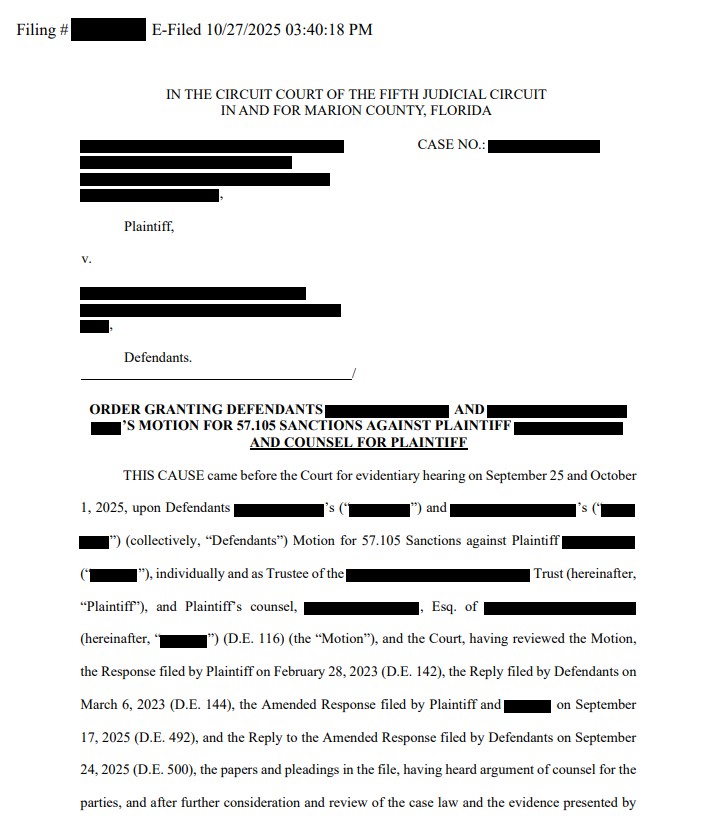
The safe-harbor notice accomplished exactly what the statute was designed to achieve. Before the 21-day period expired, the Plaintiff voluntarily dismissed the second lawsuit. No hearings were required. No motions were argued. The dismissal achieved the effect of sanctions without burdening the Court, while reinforcing the strength of the summary judgment ruling and the Defense’s credibility.
Integrating Fee Recovery with the Sanctions Strategy
While the § 57.105 demand resolved the duplicative lawsuit before it gained traction, its significance extended beyond deterrence. It also reinforced and strengthened the Defense’s ongoing efforts to recover attorneys’ fees stemming from the orginal action.
Following summary judgment, the Defense timely filed its Motion for Entitlement to Attorney’s Fees under Rule 1.525. The Court granted entitlement, expressly finding that the Proposal for Settlement complied with the governing rules, was made in good faith, and applied to the monetary claims asserted. That ruling established a baseline period of recoverable fees tied to the original lawsuit and confirmed the Defendants as prevailing parties.
The sanctions process under § 57.105 complemented this entitlement ruling. The Plaintiff’s attempt to bring a second, legally barred lawsuit, even after the Court’s findings, highlighted the same deficiencies the Defense has raised for years. The voluntary dismissal in response to the § 57.105 notice documented a continued pattern of litigation conduct that the Court consider when assessing the reasonableness and scope of fees.
In this way, the Motion for Entitlement and the § 57.105 process operated in tandem. The entitlement ruling secured recovery in the original case. The sanctions framework ensured that the Plaintiff could not undermine that victory by initiating a second, equally unsupported action. Together, they advanced the same goal: achieving financial finality in parallel with legal finality.
The Economic of Litigation Strategy
The fee-entitlement phase of litigation often reveals the deeper economic structure of a case. Many clients view defense work as purely reactive, a necessary cost to mitigate exposure. But when recovery mechanisms are integrated into a defense strategy from the beginning, the economic dynamic shifts. Litigation becomes a controlled sequence of actions designed to convert legal success into financial recovery.
Here, each procedural milestone served both a substantive and economic purpose. The summary judgment ruling resolved liability. The Proposal for Settlement secured fee entitlement. The § 57.105 notice prevented duplication and reinforced the reasonableness of the Defense’s position. The cumulative record justified not only dismissal, but reimbursement.
Litigation as a Continuum: The Final Lesson
The coordinated use of a summary judgment, the Proposal for Settlement, and § 57.105 illustrates the value of treating litigation as a continuum rather than a succession of disconnected battles. From the first day of representation, every decision was evaluated for how it positioned the client not just to prevail, but to achieve finality: legally, procedurally, and financially.
The result was more than a defense victory. It was a case study in how strategic sequencing can secure dismissal, deter relitigating, and obtain reimbursement, transforming litigation from a reactive exercise into a proactive tool of risk management.
Jocelyne A. Macelloni is a partner and director of education at Barakat + Bossa PLLC. Board-certified by the Florida Bar in business litigation, Ms. Macelloni has spent more than a decade representing businesses and business owners in courts and arbitrations around the U.S., including in cross-border transactions and disputes that involve enforcing factoring companies’ and secured creditors’ rights. Her practice focuses on helping companies resolve complex disputes efficiently—by identifying winning strategies early, minimizing risk, and turning litigation into a controlled, strategic process rather than a reactive one. For assistance, Ms. Macelloni can be contacted at jmacelloni@b2b.legal.
This post is intended to provide general information regarding civil litigation strategy in Florida and does not constitute specific legal advice. For guidance tailored to your situation, please contact our team directly.