Written by: Brian Barakat, Esq.
Imagine waiting more than two decades for a clear answer on a rule that impacts almost every major civil lawsuit in the state.
For 27 years, Florida trial courts and litigators have been operating in a state of deep procedural confusion. Ever since the Florida Legislature updated the state’s punitive damages laws in 1999, a quiet but fierce battle has waged over a seemingly simple question: What exactly does a plaintiff have to prove just to ask for punitive damages?
The wait is finally over. In the case of Federal Insurance Co. v. Perlmutter (Case No. SC2024-0058), the Florida Supreme Court stepped in to resolve a long-standing, multi-district conflict, providing much-needed clarity on how trial courts must conduct a punitive damages hearing.
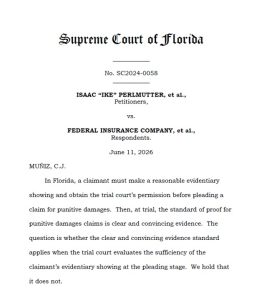
[Click to Read the Full Florida Supreme Court Opinion]
The 20-Year Legal Logjam
To understand why the Perlmutter decision is such a massive milestone, you have to look at how we got here.
Under Florida Statutes § 768.72, a plaintiff cannot simply request punitive damages—which are designed to punish a defendant for gross negligence or intentional misconduct—in their initial complaint. Instead, they must first make a “reasonable showing” to the trial court that a “reasonable basis” for recovery exists.
However, in 1999, the legislature raised the burden of proof at trial to an exacting “clear and convincing evidence” standard. For decades, the courts were split on how to blend these two rules together at the early pleading stage.
The division fundamentally split Florida’s District Courts of Appeal into two opposing camps:
The “Four Corners” View (Second and Fifth DCAs)
Anchored by the 2005 decision Estate of Despain v. Avante Group, Inc., these courts believed the pleading stage was just a basic gatekeeping mechanism. They argued that a judge should look at a motion to amend similarly to how they look at a standard motion to dismiss—focusing almost strictly on the plaintiff’s allegations and evidence, without forcing them to meet the high “clear and convincing” trial standard right out of the gate.
The “Totality of the Evidence” View (Fourth DCA)
The Fourth District threw a wrench into this consensus. They argued that the statutes must be read together, meaning a trial court must look at the “totality of the evidence” identified by both sides. They certified a question of great public importance to the Florida Supreme Court, asking if a trial judge must determine whether a reasonable jury, looking at everything in a light most favorable to the plaintiff, could actually find by clear and convincing evidence that punitive damages are warranted.
This split meant that whether you were allowed to pursue punitive damages often depended entirely on what county your lawsuit was filed in.
The Catalyst: Flooding the Appellate Gates
As highlighted by appellate expert David Thomas Valero in The Florida Bar Journal, this underlying tension boiled over due to a crucial procedural change. In 2022, Florida Rule of Appellate Procedure 9.130 was amended to allow immediate, nonfinal appeals of orders that grant or deny a motion to amend to add punitive damages.
Suddenly, instead of waiting until the very end of a multi-year trial to appeal a punitive damages ruling, lawyers could appeal them instantly. This procedural shift flooded the appellate courts with punitive damages disputes and forced the Florida Supreme Court’s hand to finally resolve the Perlmutter conflict.
What the Supreme Court’s Direction Means for Litigators
By resolving SC2024-0058, the Florida Supreme Court has finally established a uniform, predictable playbook for trial judges and civil litigators across the state.
For years, hearings on motions to add punitive damages were unpredictable wildcards. Some judges would refuse to look at a defendant’s counter-evidence, treating the hearing like a quick, face-value review of the plaintiff’s paperwork. Others would conduct exhaustive mini-trials.
The Supreme Court’s resolution cuts through the noise. It clarifies the exact standard of proof required at the evidentiary hearing stage, settling whether a trial court must weigh the defendant’s conflicting evidence before granting a plaintiff the right to claim punitive damages.
The Takeaway
For businesses, individuals, and trial attorneys in Florida, Perlmutter changes the calculus of civil litigation. Punitive damages claims completely alter the leverage in a lawsuit—they open the door to intrusive financial discovery and expose defendants to massive financial ruin.
Thanks to the Supreme Court finally stepping up to clear the air, parties on both sides of the aisle finally have a clear roadmap. The era of geographic luck-of-the-draw in Florida punitive damages hearings is officially over.
Credit & Context Note: Background analysis regarding the legislative history of F.S. § 768.72, the historic district court conflicts (including the Despain and Deaterly lineages), and the impact of the 2022 amendment to Fla. R. App. P. 9.130 was informed by David Thomas Valero’s article, “The Florida Supreme Court’s Imminent Resolution of the Perlmutter Conflict,” published in The Florida Bar Journal (Vol. 100, No. 3).
Brian Barakat is a Board-Certified Business Litigator and Co-Founder of Barakat + Bossa PLLC. With a background in prosecuting complex financial fraud and a career built on high-stakes commercial litigation, he brings strategic insight and courtroom experience to every matter. His practice focuses on resolving business disputes efficiently and effectively, with particular emphasis on fiduciary litigation, restrictive covenants, and fee recovery. He may be reached at barakat@b2b.legal.
This post is intended to provide general information regarding developments in Florida civil litigation and does not constitute legal advice. For guidance tailored to your situation, please contact our team directly.